Silicosis: The deadly threat to thousands of Hispanic workers in North Carolina
The lung health of countertop workers is under serious threat as they cut the stone we later see in thousands of kitchens. Here’s everything you need to know about this incurable disease and how to claim compensation regardless of your immigration status.
Charlotte – The artificial stone countertops that adorn thousands of new kitchens in Charlotte and throughout the state have a cost that doesn’t appear on the bill.
Those who cut, sand and polish them, unknowingly breathe in a fine silica dust that remains in their lungs forever.
The result is silicosis, an incurable lung disease . It is an invisible enemy that lodges permanently in the lungs, and its damage, often fatal, manifests itself years later.
Its main victims are Hispanic workers , both from North Carolina and the rest of the United States.
What are artificial stone countertops?
Countertops , as they are known in English, are the smooth, elegant and modern surfaces that go on top of the kitchen or bathroom furniture for preparing food or placing the sink.
Although they look like natural stone such as granite or marble, they are manufactured industrially, that is, in factories , by mixing ground quartz (up to 95% silica) with glues and resins.
Why are they so dangerous in workshops?
These tiles arrive in large blocks at the cutting and finishing workshops. To adapt them to the exact dimensions of a kitchen, the workers, mostly Hispanic , must cut them, polish the edges, sand them, and cut the holes to fit them in the sink.
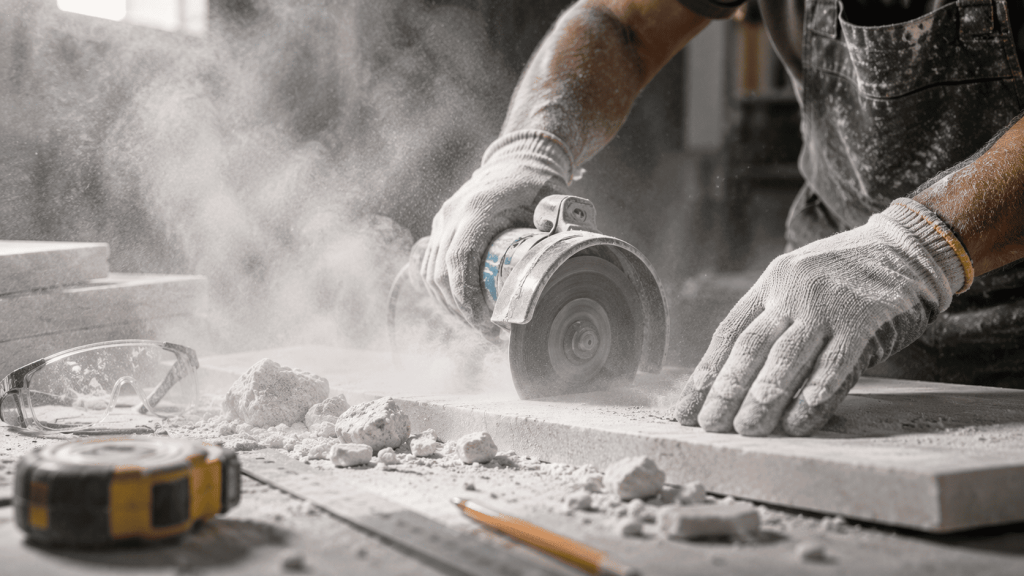
When cut or polished dry, without the use of water, dust extractors or proper respirators (and not just simple masks), these slabs release an ultrafine, invisible cloud of dust that enters directly into the bodies of those working in the workshop.
And while that person continues working there, that fine dust is both scarring and hardening the lung tissue , so that it will gradually lose its ability to receive oxygen.
The next thing you know, a simple act like breathing will turn into a daily struggle for air until you become dependent on an oxygen tank or need a lung transplant to live.
The countertops that look like natural stone and are in such high demand are actually manufactured in workshops where most of the workers affected by silicosis are Latino. Photo: Magnific.
The deception of the first symptoms
According to public health specialists, silicosis does not produce immediate pain or early warning signs.
In its initial stages, silicosis usually manifests with a mild cough, constant fatigue or shortness of breath , so many workers mistake it for a simple cold, smoker’s cough, asthma or pneumonia.
Exposure is also associated with lung cancer, COPD, rheumatoid arthritis, and kidney disease.
There are three main forms of this condition:
Chronic: Appears after several years of prolonged exposure and progresses gradually.
Accelerated: It develops in a few years when working with synthetic quartz stone and usually requires a lung transplant to avoid death.
Acute: Arises within months following massive exposures and causes severe respiratory failure.
A danger with no official figures in North Carolina
In California, the state that best monitors silicosis, the Department of Public Health confirmed 592 cases linked to artificial stone as of June 2026.
Of these, 580 (98%) are Latinos; 65 needed a transplant and 31 died, at an average age of 52.
But North Carolina does not publish a public record of cases .
In December 2023, the state Department of Labor (NCDOL) included silica in a special inspection program and classified the manufacture of artificial stone countertops as “an emerging risk.”
Despite the lack of official statistics, lawyers handling these cases point out that the threat is present in dozens of cutting shops in cities like Charlotte, Concord and Salisbury , as well as quarries in the western part of the state, in the Asheville area.
All of them employ a large number of Latino immigrants.
Infographic created with own information using IA/QP.
Research and advocacy for Hispanic workers
Concern about not letting the danger of silicosis go unpunished has led some law firms in the state to thoroughly study its impact on the Latino community.
Wallace & Graham, PA, a renowned law firm based in Salisbury , has been successfully litigating silicosis and lung cancer claims for Hispanic and other workers for years.
Their lawyers, who represent affected workers, emphasize that North Carolina law allows these workers, including undocumented ones, to seek compensation from their employer’s insurer and sue the tile manufacturers.
But those rights have an expiration date. For workers’ compensation, the clock doesn’t start until a “competent medical provider” informs the worker that they have the illness.
That’s why lawyers first check when silicosis was diagnosed and when a doctor linked it to stonework.
Anyone who lets the deadline pass loses the right to claim, even if their case is solid.
In North Carolina, there are three legal paths for a worker with silicosis or their family, and each has its own timeline:
Workers’ Compensation: The worker has 2 years from the date the illness incapacitates him from working and a doctor confirms the relationship with his employment.
Civil lawsuit against manufacturers: You have 3 years from the medical diagnosis and official information on silica exposure to file a lawsuit for injuries against the companies that manufacture the tiles.
Death: If the worker dies from the disease, the family has 2 years from the date of death to initiate legal action.
Doctors, workers, and lawyers warn that the high content of crystalline silica makes this material a risk that is almost impossible to neutralize in practice in workshops. Illustrative image with IA/QP.
Immediate steps to protect yourself
In that regard, they recommend that countertop workers see a doctor immediately if they experience a persistent cough or fatigue and inform the doctor about the type of stone they cut or polish.
They also suggest keeping pay stubs, photos of the workshop, and proof of the tile brands used to support any future claims.
A free support and consultation resource
If after reading this you have any doubts or questions, Wallace & Graham, PA maintains a specialized team dedicated to investigating these cases and providing guidance in Spanish to workers who suspect they are ill and wish to know their rights.
Call and request direct assistance in Spanish: 1-800-849-5291.
Free evaluation: The review of each case is free, confidential and does not require a report on the worker’s immigration status.
Despite the lack of official statistics, lawyers point out that the threat of silicosis is present in dozens of meat processing plants in cities like Charlotte, Concord, and Salisbury, as well as quarries in the western part of the state, in the Asheville area. Photo: Magnific.
What to do, step by step
1. Go to a doctor and tell them what you do for a living. Tell them you cut or polish artificial stone. A proper diagnosis usually requires a CT scan or chest X-ray, pulmonary function tests, and sometimes a biopsy.
2. Request a written diagnosis. Keep the document where the doctor states that you have silicosis and that it is related to your work. That date is the starting point for the legal process.
3. Note the deadline. Count two years from the date the illness prevented you from working for workers’ compensation, and three years from the diagnosis to sue the manufacturers. If a family member died, count two years from the date of death.
4. Keep evidence of your work. Employer names, dates, brands of the tiles you cut, photos of the workshop, and pay stubs.
5. Consult a lawyer as soon as possible. Several law firms in the state offer free consultations in Spanish. Don’t wait until the last month: preparing a claim takes time.
6. Protect your coworkers. Any worker can file a complaint with the NCDOL for exposure to silica dust in their workshop.


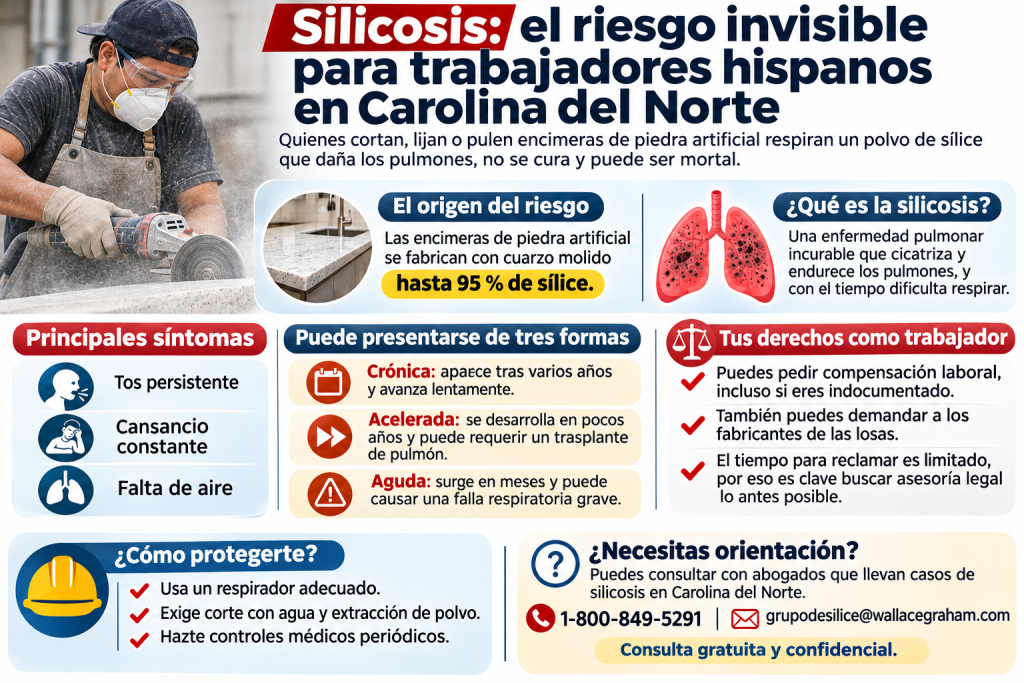 Infographic created with own information using IA/QP.